Showing posts with label Kaikoura. Show all posts

29 January 2019

South Island Tour


Tell me about a complicated man.
Muse, tell me how he wandered and was lost
when he had wrecked the holy town of Troy,
and where he went, and who he met,
the pain he suffered in the storms at sea.
- Homer The Odyssey (modern translation)


The road to Mt Cook.


We have just returned from another epic Highstead adventure. Sixteen days of driving, tramping, and camping on the South Island. The trip was undertaken during the height of summer holidays and tourist season around here, so we designed our route to avoid the crowds as much as possible. In total, we covered a little over 3,400 km (2,100 mi), almost entirely on minor highways and roadways. A surprising amount of it was on unsealed/gravel roads. Along the way, we stayed in a mixture of small baches/cribs intermingled with a lot of tent camping. Despite the huge crowds out at this time of year, we felt like we had the roads mostly to ourselves.

Most people touring the South Island are a little limited in their choice of route. There are only a few places to pick up a hire car or campervan, and the most popular seems to be Christchurch. From there, the most common route is to head north and do a big anti-clockwise loop. We were fortunate to be arriving into Picton by ferry and knew we could start in either direction. Additionally, we had already spent time in Christchurch/Akaroa (Link: Moving Pictures & Signals) as well as in Dunedin (Link: Summertime & One Tonne) and Oamaru (Link: Steampunk'd), so we could skip the southeast coast. In the end, our route took us clockwise from Picton to Kaikoura, then inland to the Rakaia Gorge and onto Mt Cook. From there, we jumped down to the Catlins, bypassed Invercargill, and headed for the Fjordlands. We finished our trip on the West Coast. Camping and sleeping in a tent meant that we had no schedule and nowhere to be. We could drive as far as we wanted, pitch our tent, and explore the local area. Every few nights, we stayed in a bach/crib so we could dry out, shower, and do some laundry.


Day 1-2 - Palmy to Wellington, Picton to Kaikoura

Loading the ferry - Wellington to Picton.


Te Moana-o-Raukawa is the tempestuous strip of water that separates New Zealand's South and North Islands. The English name is Cook Strait, and it is considered one of the most dangerous and unpredictable bodies of water in the world. The narrowest part of the strait is only 22 km wide, but the ferry crossing between Wellington and Picton takes about 3.5 hours. On the South Island, the section through Marlborough Sounds is one of the most scenic and dramatic that I have ever experienced. This would be my 5th crossing, and the ferry was packed, so we claimed some space, stayed below, and camped out for the journey. Despite the strait’s terrible reputation, I have never experienced a difficult crossing, but JRH did on her way to school camp a couple of years ago. Their crossing was so rough that cars slid around on deck and smashed into each other.

Picton to Kaikoura is another 2 hour drive, making for a lot of sitting/driving on our first day of travel. The original plan for our trip was to limit driving to only 3-4 hours each day. We wanted to explore the South Island, not zoom through it. Unfortunately, there was no way to avoid a couple of long days. Fortunately, we couldn't check into our bach until after 5p, so we weren't in much of a hurry. This time of year, the sun rises at about 5:30 and doesn't set until after 9:30p, giving us plenty of light well into the evening. Unfortunately, the weather didn't cooperate (skies were grey and overcast) and much worse, we lost our Lonely Planet guide, so we didn't take any side trips or detours. Our goal was lunch at Nin's Bin ... a roadside trailer serving what is reportedly some of the best local seafood. Seating is outside only and it was raining. We weren't prepared to brave "liquid sunshine" on our first day, so we passed it by. We had 15 days of outdoors adventures planned, and particularly on the west coast where it rains 200+ days each year, doing things in the rain would become a theme ... just not on Day 1.


Te Ahi Kaikoura a Tama ki te Rangi (Kaikoura) was established in 1853 as a whaling station, and it's name means "Meal of Crayfish" (crayfish here being what the rest of us call spiny lobster). Crayfish is on the menu all over town, but some of the best food here is at roadside trucks/trailers. Since we missed out on Nin's Bin on Day 1, the next day saw us picking up the slack at Kaikoura Seafood BBQ. Like anywhere else in the world, crayfish/lobster here is crazy expensive and JRH was shocked when she saw the sticker price on the tail we ate for lunch. She doesn't eat seafood, so couldn't experience for herself how each bite was worth every penny.

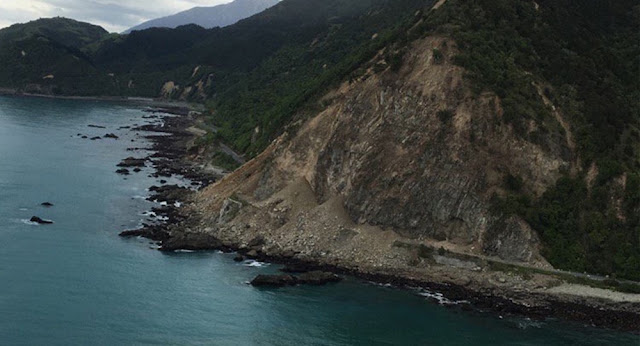
On 14 November 2016, there was a magnitude 7.8 earthquake centred approximately 60 km south-west of Kaikoura. The quake occurred at a depth of only 15 km, involved 6 different fault lines, and was comprised of two separate but concurrent events. I went into a lot of detail regarding the science and our experience here. Suffice it to say that it was a life-changing event for both Kari and me. While we felt quite a rumble 150 km away, the local results were devastating. New Zealand sits on the Ring of Fire, one of the most geologically active areas in the world, and the seabed surrounding Kaikoura has been rising at a rate of a few mm per year, but the Kaikoura earthquake instantly raised the seabed 0.5-2 metres. It completely changed the landscape, altering reefs, fisheries, and fur seal colonies. In addition, nearly 200 km of road was damaged along with an equal amount of rail line. Opening the only major roadway into Kaikoura took a little more than a year, required over 2 million work hours, and came at a cost of over $1.1 billion.


Kaikoura's alien landscape.


One of the things we have discovered on our travels is that you just can’t do it all. Everywhere we go, there is so much to see and do but just not enough time to fit it all in. Our strategy is to identify a bunch of things we would like to do, then each of us gets to pick one thing that we absolutely will do. For this trip, my choice was sea kayaking. Up and down the coastline there are dozens of places to put a kayak in and go for a paddle ... and plenty of companies willing to take your money to see it all happen. Unfortunately, for most of them, JRH was not old enough. In Kaikoura, though, we found one that was more “family friendly”. We chose the morning paddle hoping for better weather and we weren’t disappointed.

Once they got us all to the put-in and gave us a safety briefing (in the event of an earthquake or tsunami, paddle further out to sea to deeper water!), we were on our way. With the size of our group, they split us into two, so the three of us were lucky to have our own private guide. She got us right up close to some seals and let us paddle out into the ocean swells. Maria was awesome and I can’t say enough great things about Kaikoura Kayaks.


On the water with Kaikoura Kayaks.


Shoreline exploring.


Summer in these latitudes means long days with loads of sunlight. After our paddle, we had time for lunch followed by a long tramp along the shoreline then back along the cliffs. That still left us plenty of time to get back to our bach, shower, and head out for some sunset views and a late dinner. All in all, it was a great start to our long holiday.


Stay tuned, there's more to come ...

18 November 2016

2016 Kaikoura Earthquake


Well I said shake, rattle and roll
I said shake, rattle and roll
Well you don't do right
To save your doggone soul
Shake, rattle and roll
- Jesse Stone


Moving to New Zealand, we knew we were moving to a geologically active area of the world. We knew it intellectually, but this week we got to know it viscerally.

In January/February 2014, we came to New Zealand on holiday. We had an idea we wanted to work and live here, so we headed across the Pacific for a scouting trip and for a holiday to experience as much of New Zealand as we could before committing to a contract sight unseen. We had just under two weeks, and we knew we couldn't see everything, so we made plans to hire a caravan and explore the North Island. The caravan idea came about from the suggestion of friend with whom I worked and occasionally played golf. It was on the golf course that he told me about his trip to NZ and about "caravaning".  And it was during that conversation that I first heard about New Zealand and earthquakes. He had been to NZ a couple of years before and had wanted to go to Christchurch during his visit. Unfortunately, he was unable to do so because ChCh experienced a magnitude 6.3 earthquake in February 2011, just before he arrived.
 
The epicenter of the Christchurch earthquake was close to City Centre (10km/6mi) and it was relatively shallow at 5km/3mi underground. The quake only lasted about 10 seconds but it caused massive damage. In the downtown core, 45% of the 3000 buildings were eventually tagged as unsafe and by February 2015, 1240 had been demolished. 170K buildings and homes were damaged and 11.5K required demolition. Six years later, the city has only partially recovered. The economic impact has been nearly equal to that of Hurricane Katrina but because of insurance disputes many people continue to live in severely damaged homes.

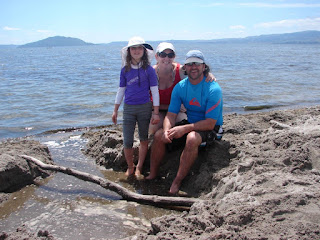
On our trip to New Zealand, we didn't experience any earthquakes (that we noticed), but we did take advantage of the fact that NZ is geothermically active. One of our first stops was at Hotwater Beach. Its name comes from the underground hot springs that filter up through the sand. People dig holes in the beach that then fill up with hot water. The water can get so hot as to be unbearable. We didn''t have shovels so digging holes was somewhat laborious. We had a similar experience on the shores of Lake Rotorua and this time we had digging tools. Our beach "hot tub" was so hot we had to dig a channel to the lake to allow cooler water to flow in.


Adoptee Beach Hot-tub Proud diggers


I have felt earthquakes in other places I have lived and traveled, but they were more of the "what was that?" kind of experience and then only later finding out there had been an earthquake. Kari has never been through a quake before this week. A few minutes after midnight on 14 Nov 2016, I awoke to the bed shaking. It wasn't much, like someone vigorously scratching an itch, but it was going on a little long and I was getting annoyed. I rolled over to ask Kari "What the hell?" and realised that she wasn't in bed. Just about that time, I heard a rhythmic clacking. It took a second or two to recognize it as the sound of the wooden knobs on the blind pulleys smacking against the wall. I figured out pretty quickly that it was an earthquake. That's when the fun began. The bed started a slow roll, yaw, and heave like a small boat in moderate seas. When the bed started heaving, I actually got a little sea-sick. Afterward, I couldn't help but compare it to the bed scene in The Exorcist ... minus the priests and demons, of course.    


The Exorcist


Kari turned on the hallway light just about then and I called out to her to go lie down with Little H. I laid there in bed, heaving and rolling, listening to the house. If I heard anything crash, crack, or break, I would have to get my family out of there. I figured we were otherwise safest lying down on our beds. The entire episode lasted a minute or two, but it felt much longer. I was eventually able to fall back asleep. Kari was up the rest of the night.

Here's Kari's experience in her own words ...      
I woke up during the night for my usual bathroom break ... too much water before bed, after effects of pregnancy, age ... who knows, but this is part of my nocturnal life now. Anyone who knows me is well aware of my eyesight and the fact that it borders on legal blindness. With that being said, I was out on my own ... no contacts, no glasses, "Costco walking" (a Grant term ... ask him about it) and praying I make it the 20 or so feet to avoid the involuntary void. As I reached the bathroom door, I heard this bizarre noise that was clearly affecting our roof. It initially sounded like large rain drops pelting the roof, but then I thought maybe it was someone or something outside our bathroom. This further delayed my appointment with the toilet, as I was truly frightened and did not want to open the bathroom door and proceed. Fear of stress incontinence ruled and I made my way to the toilet (sorry for the visual).
As soon as I sat down, the whole room and house started swaying and it felt as if the floor was receiving rolling waves. It only took me a few seconds to realize this was an earthquake. Adrenaline kicked in, and damn it, I could no longer pee. Without meaning to sound dramatic, I found myself unable to call out to Grant, another bizarre moment because I never shut up. I think I can be described as one of the most non-dramatic individuals, so please bear with me ...
I stood to try and make it back down the hallway and to our bedroom. This posed a problem ... I have been on a couple of cruises, and certainly spent many years on the Gulf of Mexico fishing with my late father, but never in what I considered rough seas. What transpired as I walked from the bathroom to the hall would be exactly what I imagine it would be if you were trapped on a boat in a squall or rough seas. I could barely keep my balance. Crawling may have been a better option, but didn't think of it at the time. With the bathroom light off, I turned on the hallway light and set my sights on making it back to our bedroom. It was then that Grant called out to me to go to Little H's room and be with her. As I laid there, the wooden blinds in the windows relentlessly banged against the window and frame. She has a pendulum light in her room and with each sway, I feared it would be broken ... it came that close to her ceiling.
In retrospect, I am sure the quake woke me, not my bladder. This was one of the most eerie and nearly indescribable experiences I have ever been through. Little H never roused, but asked to be woken if there is another quake. I told her I hope there won't be, but if so, I would never wake her ... she would have been terrified. In fact, an aftershock came the next evening while we were watching TV. I also happened to be on the phone with my brother. I turned to Little H and asked if she felt the quake and she said 'yes'. She proceeded to ask if we would be ok, to which I replied 'yes'. She hasn't brought it up anymore and was so brave and helpful when I packed a 'grab and go' bag and parked the car outside of the garage for the night. This definitely was not on any of our bucket lists, but happy to mark it off.
We have been avidly following the news and Geonet online. This event was actually 2 overlapping earthquakes involving 6 fault lines. In total, it lasted about two minutes, but the two events overlapped for about 50 seconds. Interestingly, not only was it two separate events, but the events were two different kinds of earthquakes.  


Kaikoura Quake fault lines
With more recent analysis, it was upgraded to Magnitude 7.8        


Some of you may know me from another life ... one where I studied Marine Science and worked for an oil exploration company mapping geological structures under the sea floor. Please indulge me while I totally geek out on this stuff. For my non-science/geology/oceanography friends, earthquakes occur when parts of the Earth's crust called tectonic plates rub up against each other. These plates can interact such that one plate gets forced under while the other rides up (Convergent), both are lifted and forced apart (Divergent), or they slide along each other (Transform).


Tectonic plate movement

Quake changes


Movements along fault lines are felt as "earthquakes" and are described as a Normal Fault, a Thrust or Reverse Fault, or as a Strike-slip Fault.


Earthquake types

Fault types


The 2016 Kaikoura Earthquake was one of the largest in recent New Zealand history. The Magnitude 7.8 earthquake occurred along 6 fault lines and was comprised of two separate events; a Thrust and a Strike-slip. It has had huge environmental and economic impacts. Two people died and there was significant damage to buildings as far away as Wellington (150km/95mi) on the North Island. Multiple slips (rock slides) have cut off the only major road in and out of Kaikoura.  


Slip over highway
From the Labour.org website (I could not find photo credit)


Notice the bent railroad tracks ...

Train tracks bent Road damage
From NZ Herald website. Left photo credit Mike Scott. No photo credit available for image on Right.


Road damage ...  

Road & Track damage
From the GNS Science web site. Photo credit not available.


Locally, the rail line between Palmy and Wellington was shut down and roads between here and there were closed. There were some heavy rains South of us, and that combined with the loosening of the ground from the shaking led to some pretty significant flooding. We didn't have any damage, and other than getting a little motion sickness (no puking though), it didn't seem to affect us much, until the consequences of the closures were brought home to me at work the other night.

On Tuesday night, almost 48 hours after the earthquake, I was working in A&E. We got a radio report from one of the medical helicopters that they would be landing at our facility. On board, they had a patient with an ongoing STEMI (heart attack). He had been seen earlier at another hospital to the north of us. His STEMI had been diagnosed and he had been treated appropriately, even given thrombolytics (medicine to open the blockage in his heart) but was continuing to have pain and his ECG (electrical activity of his heart) was still abnormal. They were transferring to Wellington by helicopter to get him to a facility where they could surgically open the blockage.

When it comes to muscle damage from ischaemia (lack of blood flow), time matters. Unfortunately, the weather further South was so bad, it was unsafe for the helicopter to continue flying. Normally in this situation, we would package him up to continue his transfer by ground. However, the roads to the South of us were also closed because of flooding and slips due to the heavy rains and earthquake. There was nothing else we could do for this poor guy but watch him and hope. Just before transferring him to the inpatient CCU (Cardiac Care Unit), he told us that his pain was gone and a repeat ECG showed normalization of the wave forms. It took a while, but it would appear the thrombolytics he was given prior to his helicopter ride finally had an effect.

I always imagined that an earthquake would be like what you see in the movies ... short and violent. From what I have been reading, the kind of long-period wave activity we experienced is more typical of large earthquakes and this one was also unusually prolonged. I have never been through a quake this big before, but I'm glad we did and that everyone is alright. I will learn from this experience ... how to recognize it, what to do, what not to do, and how to be better prepared.


She'll be right, mate ...