Where are we now?
Where are we now?
The moment you know
You know ...
- David Bowie, Where Are We Now?
Holocaust-Mahnmal (Memorial to the Murdered Jews of Europe), Berlin. Photo RGH
Berlin was never in our travel plans, at least not for this trip. We knew that it was a city we would want to visit, but we also knew it was a city that would need several days, so our plan was to head from Amsterdam to Prague and save Berlin for another trip. I had designed a circle around Europe ... Amsterdam, Prague, Budapest, Venice, Nice, and Paris. From there, Edinburgh, and New York City. One of the advantages of travelling long distances by train was going to be booking sleeper cars and waking up in a new city (and not having to pay for a room for the night). By going to fewer cities, and travelling at night, we could spend an extra day or two in a couple of places.
I spent days figuring out the route, train schedules, and which trains were direct so we wouldn't have to awaken for connections. I proudly presented my masterpiece to Kari. After initially giving her nod of approval, she threw a monkey wrench into the works by coming to me a few days later and announcing that she wanted to be in Munich for Oktoberfest. I went back to the drawing board with routes, dates, and schedules. No matter how I twisted and re-routed things, I just couldn't make it work and told her so.
She insisted.
I said "No."
We are going to Oktoberfest.
Ah, the best laid plans of mice and men, eh?
This required a complete redesign of the cities we would visit and the route we would take to get to them. The problem was Munich. Getting us to Munich from the east was easy, getting us out to the west at the right time just wouldn't work. The other problem was getting from Amsterdam to Prague during daylight hours. Everything I tried was going to require at least one connection and entail a lengthy layover. In the end, we decided to take the extended layover in Berlin. The new route took us to Amsterdam, Berlin, Prague, Munich, Lyon, and Paris, then on to the UK and US. There would be no long, overnight train rides.
Brandenburger Tor (Brandenburg Gate). Photo RGH
We arrived in Berlin during that golden hour of light surrounding sunset. The Brandenburg Gate was stunning, lit by both soft orange hues from the setting sun and the warm glow of spotlights. It was poised against a deep blue, cloudless autumn sky. We saw it through the windows of a taxi doing Mach 1 along city streets. We would get to the gate the next morning, but had only the one night in Berlin, and would not get a second chance to see it lit. The photographer in me wept.
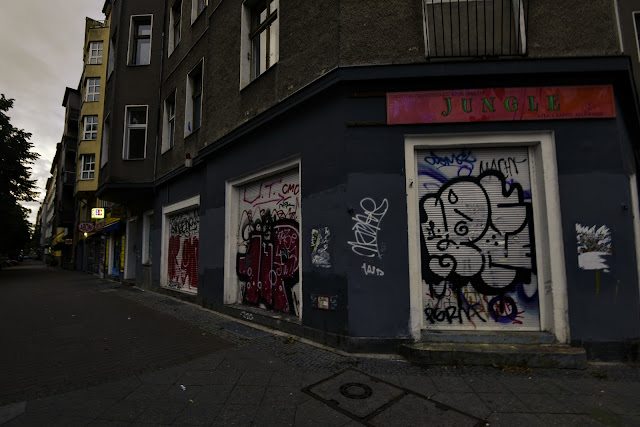
The neighbourhood of our apartment looked pretty dodgy when the taxi dropped us off. There was trash strewn along the sidewalk and graffiti covered every available space. Of course, I was nominated to brave the night and find us food. Just down the street was Piri's, a dive chicken and burger joint. I sat outside enjoying a beer and watching the local talent walk by while I waited for our order. Let me tell you, no hyperbole, that might have been the best damned burger I have ever tasted. Forever-ever. I ate Little H's leftover chicken sandwich for lunch the next day, and it was good, but it didn't hold a candle to the burger.
Street views, Kreuzberg. Photos RGH
Still feeling the effects of the 7-hour time difference, I was up early the next morning and out the door to shoot while the light was soft. I had thought about buying a walking stick/monopod combo when we were in Wellington and now regret not doing so. Because of camera shake, I'm discarding far too many potentially good photos.
We had another Sandemans tour scheduled for the day, but first we had to walk the 5 km into town. Kreutzberg, where we were staying, has a large Turkish population, so along the way we had some Turkish coffee to kickstart the pace. As we approached the Embassy District, the buildings became more imposing, but much newer; a reminder of the devastation wrought by the Battle of Berlin and the subsequent reconsctruction under communist rule. Just before arriving to our destination at the Brandenburg Gate, we crossed Checkpoint Charlie. Nothing there is original anymore. It's all a reconstruction and a tourist trap, but if you can blur out the neon glow provided by McD's and KFC, you can almost imagine what it might have looked like.
Checkpoint Charlie. Photo RGH
Berlin street views. Photos RGH
Our Sandemans tour started at the Brandenburg Gate (1791). Atop the gate sits a statue of a Quadriga bearing Eileen, the goddess of peace. She was supposed to protect the city of Berlin and keep it from harm for all of eternity. In the same square where the tour began, sits the Hotel Adlon and it's famous Royal Suite. The guest list reads like a Who's Who of 19th and 20th century great thinkers, luminaries, politicians, royalty, and Nobel prize winners. More recently, it has seen a string of names from the Hollywood elite. Unfortunately, most of us know it from the infamous Michael Jackson baby-dangling incident.
The Battle of Berlin (16 Apr - 2 May 1945) was the last major offensive battle in Europe during WWII. The German garrison surrendered on 2 May, but skirmishes continued to the west for another 6 days as German forces fought their way westward to surrender to the Allies rather than the Russians. Berlin today continues to bear the emotional and physical scars. Many of the buildings, monuments, and statuary are marked with bullet holes. Large buildings show entire sections of dark and light blocks where repairs have been made, and the Berlin Cathedral retains sections blackened by incendiary bombs. We stood in a plain gravel car park, underneath of which was Hitler's bunker. Non-descript, un-marked, all but forgotten.
Hotel Adlon. Photo RGH
Goethe in the Tiergarten. Notice the bullet pock marks. Photo RGH
Konzerthaus Berlin (1821). Photo RGH
Berlin Cathedral (1905). Photo RGH
Berlin Wall looking west from the Luftwaffe building in the east. Photo RGH
Sunday morning, August 13 1961, the people of Berlin awoke to a new reality. Up until they went to bed on Saturday night, Berliners crossed the divide between East and West fairly regularly. Some lived on one side and worked, owned businesses, or went to school on the other. Families were often separated by what was essentially a soft border. The next morning, the border was demarcated by razor wire and armed military patrols with orders to shoot anyone who attempted to cross. Overnight, people had lost their jobs, their livelihoods, had no access to their schools, and were permanently separated from their families and loved-ones. The effects would last well beyond the toppling of the wall on 9 November 1989. Rob, our Sandemans tour guide, told a story of love, deceit, and redemption that he swore was true.
On Saturday 12 August 1961, our man and his love went to their separate homes, hers in the east and his in the west, secure in their undying love and their future together. The next day, they were separated by only a few hundred meters, but were worlds apart. Nevertheless, our man vowed to wait as long as it took to be united with his love once again. They kept in contact by secret notes and by watching for each other across the divide.
As time went by, our man heard rumors of others obtaining travel visas to the East. Eventually, he hatched a plan to bribe a border guard to provide him with a "diplomatic" visa so he could cross the border and hold his love, if only briefly. He worked and saved, trying to ferret away the necessary funds.
Walking along the street one day, he saw a woman who exactly resembled his love. He ran to her, only to discover that the woman in question was not his love, but her doppleganger. And that's when he hatched his devious plan. He wooed her and won her over. He won over her family. He won over her friends. And when the time was right, he took her on holiday ... to East Berlin.
On that fateful day, they crossed from West to East with all the appropriate papers. At the appointed time, our man pulled the car over and pushed his new girlfriend out the door, retaining her papers. He drove around the corner where he picked up his love and made a beeline for the border, gaining safe entry to the West.
Needless to say, the girlfriend was quite distraut. She was in what had become a foreign country, with no money, no ID, and no way to return home. As you can imagine, she raised quite a fuss. Her parents, people of some standing, also raised a fuss when her disappearance was noted. It was discovered where her predicament had landed her and she was ultimately returned to the West.
On her return home, she contacted the police and our man was arrested. He plead no-contest, was sentenced to seven months in jail, and served his time. He was released to live happily ever after with the love of his life.
Hero or scoundrel? Fact or fairy tale? It is for you to decide.
The wall holds such a large stature in popular culture and mythology, I was surprised at how small it is ... only 3.6 metres high. Broken and chipped away, crumbling, it was such a small thing to behold and yet an enormity to ponder.
Shortly after our visit to the wall, we were headed back to our apartment to retrieve our bags and set off for the train station. Next stop, Prague.
Czech, please ...